
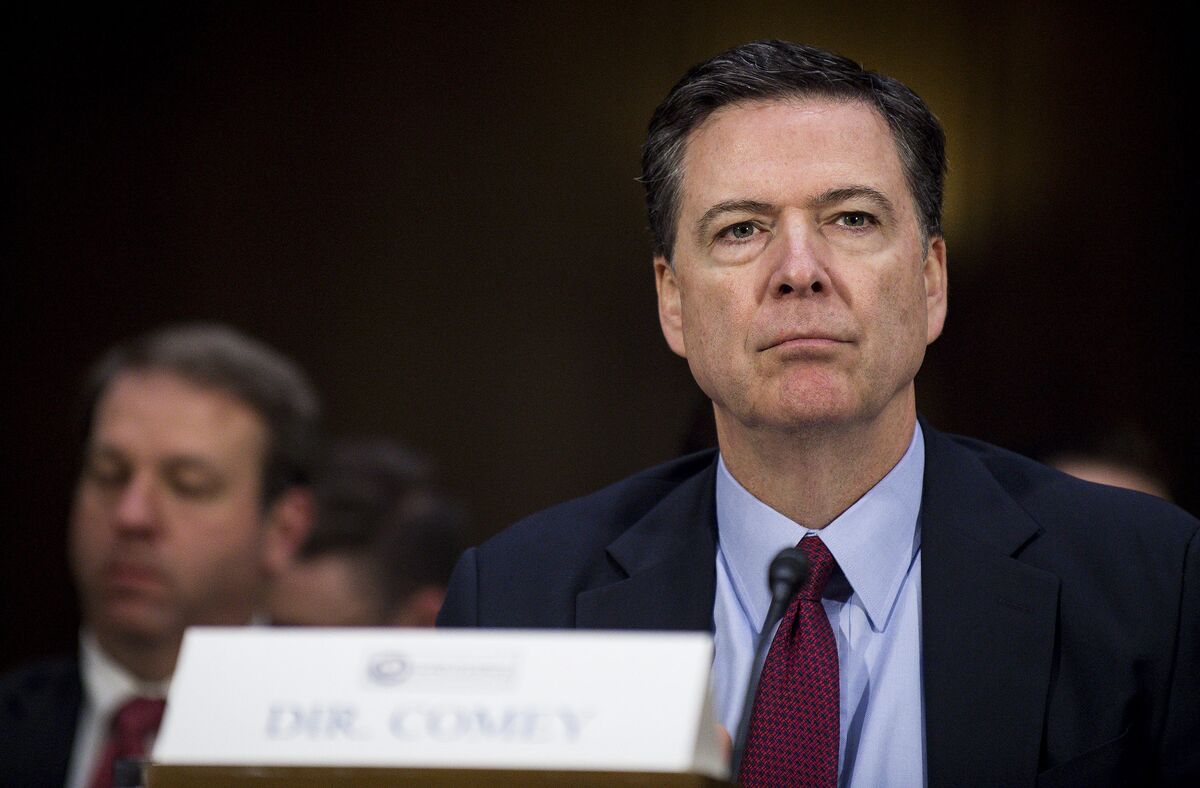
President Donald Trump’s firing of FBI director James Comey is an unwelcome distraction for a White House already straining to enact its agenda and could hamper its efforts to pass a repeal of Obamacare and cut taxes.
Comey’s ouster on May 9 polarized Democrats and unnerved some Republicans, overshadowing almost all other business at both the Capitol and the White House. Trump’s aides and his congressional allies struggled on Wednesday to defend the decision, diverting precious time from other key issues.
With limited manpower and political capital, the White House and Congress can wage war on a finite number of fronts. Trump is already mired in a battle over health care and is preparing for a fight over government spending, pushing his plan to slash corporate and individual taxes further into the future. All of that gets harder with the need to confirm a new FBI director and fend off demands for an independent Russia investigation.
"The West Wing isn’t a huge operation and it can only handle so much," said Doug Holtz-Eakin, president of the conservative advocacy group American Action Forum. When Holtz-Eakin was chief economist for George W. Bush’s Council of Economic Advisers, he recalled that work ground to a halt when Bush abruptly fired his Treasury secretary, Paul O’Neill.
What happens to Trump-Russia Probe After Comey: a QuickTake Q&A
The Comey saga doesn’t immediately shake up the congressional dynamics on health care or taxes. And Wall Street largely shrugged off any impact, with the S&P 500 backing up into another record-high close.
But Trump, like all presidents, will have to be the foremost public salesman and deal maker for his legislative priorities. His personal cajoling and arm-twisting was key to pushing the health care bill through the House. He may not have the same role in the Senate, where he has fewer allies, but he will likely be called on again by Republican leadership in an eventual negotiation between the House and Senate. White House officials have said they hope to introduce a tax bill in the next month that would call for a massive cut in corporate rates.
Since the health legislation advanced to the Senate on Thursday, however, Trump has retreated from the stage. He left for his golf club in Bedminster, New Jersey on Thursday night and wasn’t seen again by reporters until Tuesday. His schedule this week has been unusually light, with no public appearances and few announced meetings. Beyond tweets, he’s made no effort to promote the health bill since it passed the House, even as a group of 13 senators began crafting their own version of a plan to repeal and replace the Affordable Care Act.
Trump spent valuable time Wednesday morning watching cable TV reports on Comey’s dismissal and tweeting insults about his political opponents. A White House spokeswoman, Sarah Sanders, said he’s preparing for his first foreign trip to the Mideast and Europe beginning next week.
Trump Bump
Sanders dismissed the suggestion that Comey’s firing might detract from Trump’s agenda.
“Frankly, I don’t think it matters what this president says. You’re going to have Democrats come out and fight him every single step of the way,” she told reporters on Wednesday. “I think that’s one of the things that’s wrong with Washington. And I think that’s one of the reasons that we’ve got to get back to focusing on those issues and, frankly, draining the swamp a little bit further.”
There’s a chance that the fallout in Congress will be limited. Republicans don’t need a single Democratic vote in either chamber to advance their top priorities, at least not until Sept. 30, when government funding runs out.
In the immediate aftermath of Comey’s firing, the GOP remained united behind Trump, with only a few Republicans expressing mild criticism of the timing of his move. Ted Cruz of Texas said it would have been better if Trump had fired Comey in his first week in office. Several Republicans are weighing whether to call for a special prosecutor. And John McCain reiterated his call for a select committee to investigate the Russia allegations. But none has yet threatened any concrete action.
Closed-Door Meeting
Indeed, even as Democrats clamored to air complaints about Comey’s dismissal, Republicans on Wednesday made their own show of getting down to business on health care.
A closed-door meeting of the entire Senate Republican conference on health care went on as scheduled, and senators said the Comey firing was barely discussed, as they focused more on the thorny question of Medicaid spending.
Inside the White House, Trump’s economic team is continuing to work on a tax bill. But eventually they’ll need the president’s personal involvement to strike a deal with members of Congress and sell the bill to the public. That may prove difficult if his attention is sapped by the Comey firing and the Russia investigation.
"What does it mean for Trump’s agenda? It does not mean anything good. One of the clear conclusions is that tax reform is dead this year," Greg Valliere, chief global strategist at Horizon Investments. "I think if the markets were hoping for a tax bill this year, they will be disappointed."
Unwanted Work
One former Republican member of Congress said he expected that Comey’s firing would generate unwanted extra work for lawmakers as constituents phone and email their offices with questions and complaints. The person requested anonymity to discuss the matter candidly.
Others said it’s too early to predict whether Comey’s dismissal will derail Trump’s legislative agenda. One Republican congressional aide working on tax legislation said lawmakers should have a better idea over the next month about whether damage from the Comey firing is lasting. Another Republican chalked it up as just one more in a string of crises the party has had to overcome as it attempts to govern.
"For the past 100-plus days, we have had a crisis du jour almost daily," said Doug Heye, a former House Republican leadership aide. "So does this get in the way, as opposed to all the other things that we’ve seen? I just don’t think so."
Even if they are able to complete health-care and tax bills, as these Republicans suggest, that’s no guarantee they’ll find enough votes in the divided GOP to pass them. That’s when it will be crucial for Republican leaders to be able to turn to an engaged president who is respected -- or feared -- to hold hands, knock heads and close the deal.
Some Republicans say Trump is already leaving them to fend for themselves in trying to explain the Comey firing.
"Everybody’s on their own," said Senator Bob Corker, a Tennessee Republican. "There’s no policy statement that’s being put out on this -- everybody’s on their own."
Procedural Wrenches
Democrats, furious over the firing even though many of them had lambasted Comey for publicly discussing the FBI’s investigation of Hillary Clinton last year, predicted legislative work would cease.
"Senate needs to focus on the constitutional crisis Trump created, not business as usual," Senator Jeff Merkley, an Oregon Democrat, said on Twitter.
But the minority party can’t do much more than slow down the chamber’s routine business.
"I’m sure they’ll make the most of it but we’re going to keep plowing ahead," Senator John Cornyn, the No. 2 Republican, said Wednesday. "I think people need to quit hyperventilating."
Either way, the Comey firing and its fallout could be the end for whatever slim hopes remained for bipartisanship on a handful of bills. Trump had maintained hope for Democratic votes on issues including infrastructure spending, said Jim Manley, a former aide to retired Senate Democratic Leader Harry Reid.
"The way things have played out over the last few months, that was always was going to be a long shot," Manley said. "But it now might be dead."
Watch Next: Trump Critics Question Memo, Timing in Comey Firing.

0 comments:
Post a Comment