
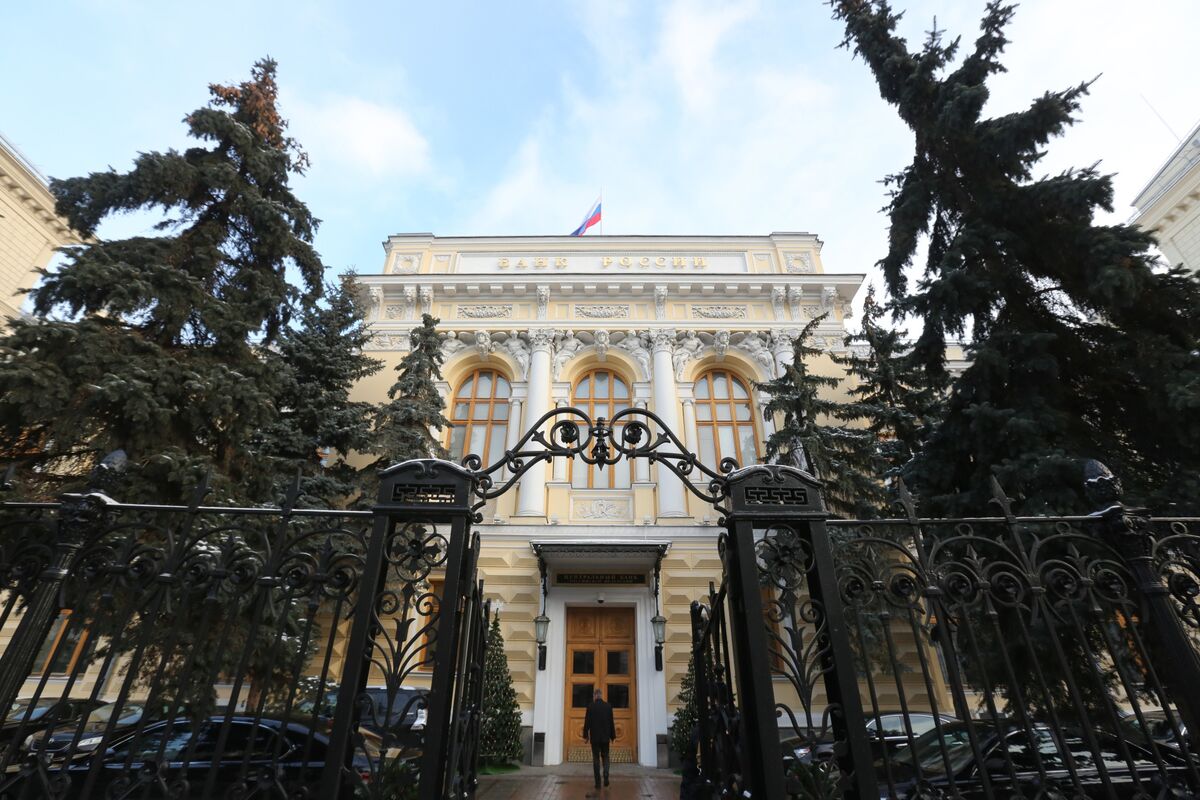
The Bank of Russia is refocusing its sights on trying to support economic growth after inflation settled at the lowest level in the country’s modern history and geopolitical risks receded.
While central banks tend to eschew efforts to look beyond their mandate, policy makers in Moscow appear willing to take on the challenge of economic growth head on. The Bank of Russia surprised with what Barclays Capital said was “one of the most dovish statements” under Governor Elvira Nabiullina when it started the year with a cut in interest rates on Friday.
“The balance of inflationary and economic risks has shifted slightly toward the risks to economic growth,” the bank said.
There’s no suggestion of broadening the Bank of Russia’s remit, which relegates the economy to secondary status and defines its mission as safeguarding the currency by means of price stability. Still, the change of tone on Friday was striking for Nabiullina, who’s repeatedly called for structural reforms and stressed that monetary policy alone can’t revive economic growth. Under her stewardship, the central bank has argued that low and stable inflation will translate into gains for the economy by encouraging savings and investment.
The shifting calculus for Nabiullina reflects the central bank’s success in bringing and keeping inflation below its target of near 4 percent following a spike in 2015 to almost 17 percent. But with presidential elections barely a month away, incumbent Vladimir Putin has to contend with an economic performance that fell far short of government expectations.
Gross domestic product added 1.5 percent in 2017, well below the 2.1 percent official forecast, following two straight months of contraction in industrial output. Even the central bank was stumped, conceding on Friday that “some uncertainty remains” in assessing the reasons for the slowdown last quarter.
“The statement had a lot to say about economic growth, but formally, under the mandate, that’s not what they answer for,” said Natalia Orlova, chief economist at Alfa-Bank. “It’s not clear to me why they’d want to take on the responsibility.”
The central bank may not have the answer for Russia’s economic malaise, but it signaled that its shift to “neutral” monetary policy could be completed already in 2018, or a year earlier than planned. The benchmark was lowered to 7.75 percent on Friday.
Still, after about two years of a “moderately tight” stance, Russia’s real borrowing costs remain among the highest globally. Nabiullina has previously put the key rate’s neutral nominal level at 6 percent to 7 percent.
“It is the first time they so explicitly mention that they may be becoming concerned about a super tight policy choking the economy,” said Liza Ermolenko, an economist at Barclays Capital in London.

0 comments:
Post a Comment