
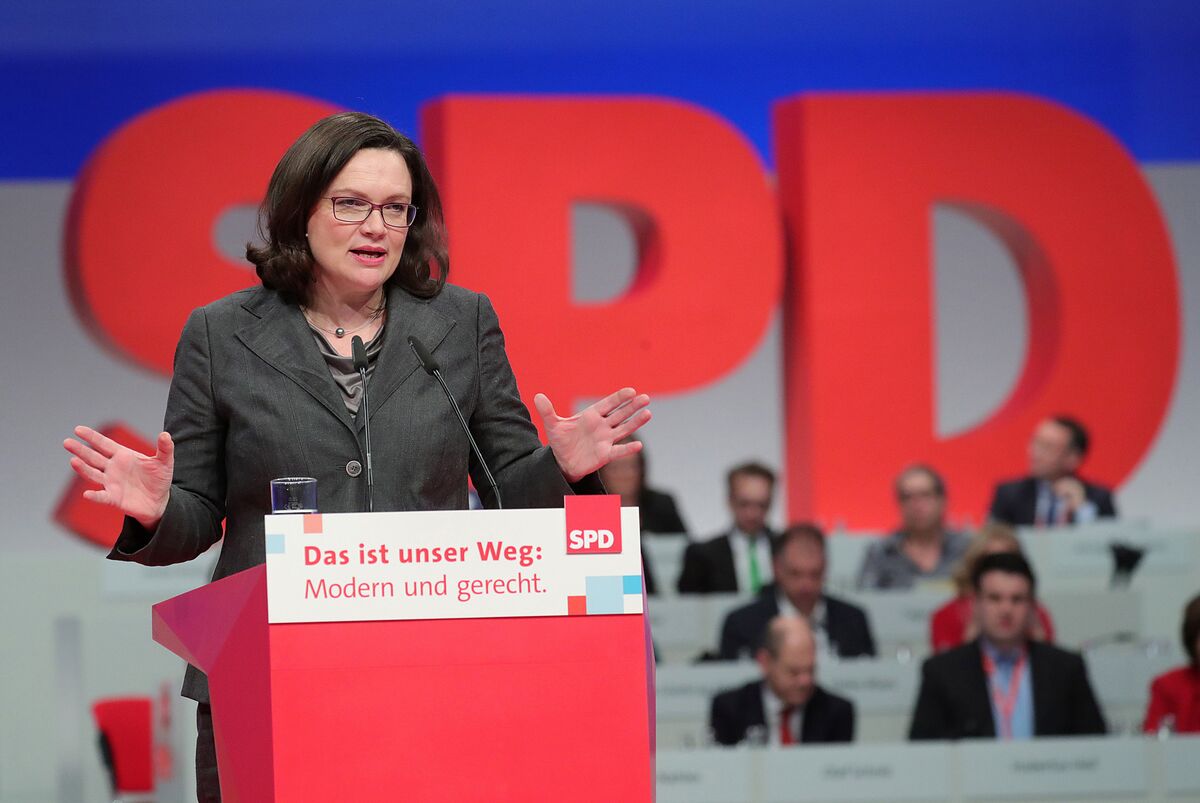
Germany’s Social Democrats are set to name their second new leader in less than a year, seeking to halt the party’s turmoil and clear the way for another government alliance with Chancellor Angela Merkel.
Top party representatives meeting Tuesday in Berlin are expected to appoint Andrea Nahles, 47, as acting chairwoman, according to people familiar with the discussions, who asked not to be identified ahead of the vote. The combative leader of the SPD’s parliamentary caucus would take the reins from Martin Schulz, 62, who fell from grace after disastrous federal elections and flipflopping over his role in a new Merkel government.
Nahles, who would be the party’s first female leader, supports the coalition pact negotiated last week, giving her a key role in persuading reluctant SPD members to back the alliance and help Merkel begin her fourth term. A vote of the SPD’s more than 460,000 members will wrap up in early March.
“She speaks the language of the party base and is therefore the right person to pitch the grand coalition,” said Carsten Nickel, a Brussels-based analyst at Teneo Intelligence. “However, the vote should be tight as the chaos of the last few days has increased the risk of failure.”
Nahles would take over more than four months into Germany’s longest political impasse since World War II, which has led the country to a choice between the stability embodied by Merkel and a bout of heightened political risk that could sweep away the current crop of leaders. Should the vote fail, Germany could be headed for new elections.
Internal Opposition
With Nahles at the helm, the SPD would hope to shore up its standing with its blue-collar base. While the move was planned, the timing was accelerated to secure support for the coalition agreement with Merkel’s Christian Democrat-led bloc, the people said. There’s a lot at stake as both parties have suffered in the polls amid frustration over the standstill.
Nahles represents a generational change for the SPD and would balance the party leadership with the more conservative leaning Olaf Scholz, the mayor of Hamburg who German media say is in line to serve as finance minister.
Still, opposition to Nahles within the SPD has emerged. Simone Lange, the mayor of the northern city of Flensburg, said she will run for the party leadership. “I can very well understand the feeling of impotence among many members caused by those who take decisions in Berlin without involving the base,” Lange was quoted as saying in German media.
‘Image of Chaos’
SPD leadership defended plans to appoint a new chair of the party before giving members the chance to vote.
“It might not please everyone but decisions must sometimes be taken so that we are in a position to act effectively,” Thorsten Schaefer-Guembel, a deputy party leader, said in an interview with Deutschlandfunk radio on Tuesday, adding that Nahles was the right person to end the party’s crisis. “It won’t help if no decision is taken and the image of chaos that has emerged in recent days persists.”
Contrary to Schulz -- an outsider for many SPD members after more than two decades of service in European parliament, rising to become its president -- Nahles is deeply entrenched in the party. She was head of the youth arm in the 1990s and emerged as one of the most prominent representatives of the Social Democrat’s powerful left wing, vocally opposing Chancellor Gerhard Schroeder’s controversial labor reforms.
Since then, she has modified her image as a socialist rabble-rouser with a solid tenure as labor and social affairs minister under Merkel over the past four years. At a critical party convention in January, she confirmed her role as a driving force within the party by rallying support of the delegates to narrowly approve negotiations with Merkel’s bloc with her impassioned plea.
“The SPD is trying to calm the public with the change in leadership,” said Carsten Brzeski, chief economist at ING-Diba in Frankfurt. “But it shows that the party is divided, and the chances that the vote is turning against a grand coalition has increased.”
— With assistance by Iain Rogers.

0 comments:
Post a Comment