
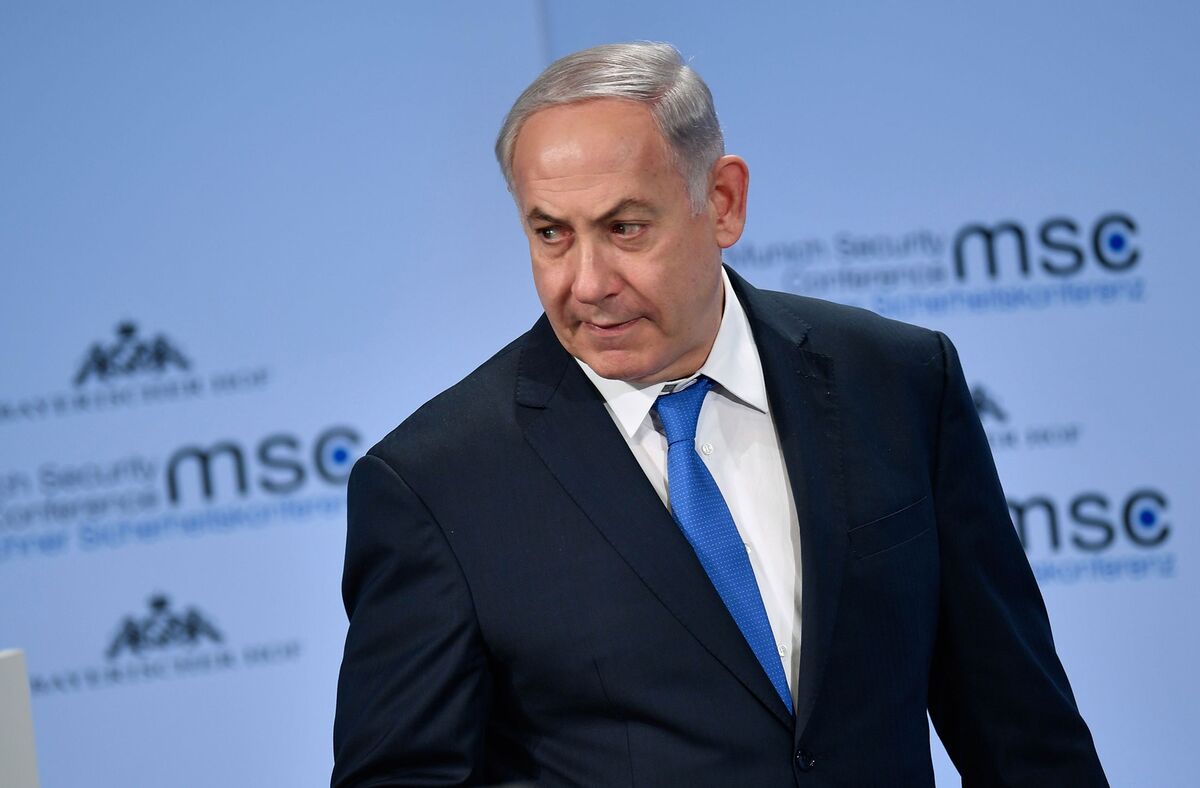
Israeli Prime Minister Benjamin Netanyahu used the annual security conference in Munich -- site of the West’s historic appeasement of Hitler before World War II -- to warn of Iran’s alleged attempts to dominate the Middle East, and Israel’s resolve to prevent it.
Iranian aggression "is in my judgement the greatest threat to our world,” Netanyahu said Sunday, urging leaders not to repeat the mistakes of Munich negotiators who failed to stop German Chancellor Adolf Hitler in 1938 for fear of provoking a war. Rather than preventing war, the Israeli leader said, their inaction “made a wider war inevitable and far more costly."
Netanyahu has used other high-profile platforms -- including the U. Congress and United Nations General Assembly -- to highlight the existential threat if Iran develops nuclear weapons. On Sunday, he focused equally on Iran’s conventional military entrenchment in Syria and the dangers it creates.
Israel feels increasingly abandoned as regional partners prioritize their often conflicting interests in Syria’s seven-year civil war, now that a common enemy -- Islamic State -- is largely defeated. That has left Israeli leaders with an unpalatable choice: Tolerate a permanent Iranian military presence on their border, or risk going to war to prevent it.
Escalation Risk
Netanyahu said Israel has stayed on the sidelines of the Syrian war to this point, acting only to stop transfers of advanced weapons bound for Hezbollah, Iran’s proxy militia and Shiite political party in Lebanon. But he said that could change if Iran establishes a new reality on the ground in Syria.
If President Bashar al-Assad allows the Iranian military to entrench itself in Syria, “then obviously he is challenging us to a different position than we’ve had," Netanyahu said. Israel is “absolutely resolute in our determination to stop and roll back the aggression of Iran’s regime."
Israeli officials believe the U. and Europe have yet to fully grasp the likelihood of military escalation. reluctance to enter the war in Syria has left it with insufficient force on the ground to dictate terms to Iran. Many Arab nations share Netanyahu’s concern over the Iranian threat, but won’t publicly support Israel for domestic political reasons.
Russia has more leverage to assure Israeli interests in Syria, and Netanyahu has held multiple discussions with Putin to ensure Israeli jets can attack when necessary in Syria without clashing with Russian forces. But Moscow appears to be prioritizing ties with Iran, which is emerging as its strategic partner.
“They like Israel, but they need Iran,” Amos Gilad, who recently stepped down as director of political-military affairs at Israel’s Defense Ministry, said in a phone interview. “They won’t remove Iran from Syria for two reasons: First of all it doesn’t suit their policy, and second of all they can’t.”
Elena Suponina, a Middle East expert at the Russian Institute for Strategic Affairs, a research group that advises the Kremlin, says escalation in Syria isn’t in Russia’s interests. But, she said, “Netanyahu is certain that he has the full support of the Trump administration, which may drive the Israelis into action.”
Netanyahu’s calls to “fix or nix” the international deal to curb Iran’s nuclear program have failed to sway much of the trans-Atlantic security establishment represented in Munich. He’s hoping a warning on the dangers of escalation in Syria -- already the source of a seismic refugee shock in Europe -- will get a more sympathetic hearing.
This month alone, U. aircraft killed as many as 200 Russian mercenaries as they attacked Kurdish forces in eastern Syria; Turkey threatened to expand its invasion of northern Syria to take on Kurds embedded with U. advisers; and Israel shot down an Iranian drone that breached its airspace.
Last week, for the first time since 1982, Israel lost a combat aircraft to hostile fire as it returned from air strikes in Syria. Israel’s retaliation in the incident, which began with the reported infiltration of an Iranian military drone into Israeli territory, destroyed as much as half of Syria’s air-defense system, according to the Israel Defense Forces.
In Munich on Sunday, Netanyahu held up a piece of metal he said came from the drone, and asked if Iranian Foreign Minister Mohammad Zarif -- who was due to address the conference later in the day -- recognized it. Iran denies it sent the drone into Israel.
“Take back with you a message for the tyrants of Tehran: ‘Do not test Israel’s resolve,’ " Netanyahu said. “Israel will act not just against Iran’s proxies that are attacking us, but against Iran itself.”
Land Corridor
Of most concern to Israel are Iran’s efforts to establish a land corridor to Lebanon via Iraq and Syria, where Islamic Revolutionary Guard Corps commanders oversee thousands of militants.
Israel’s perception that the balance of forces in the region is tipping against it is well-founded, according to Emile Hokayem, senior Middle East fellow at the International Institute for Security Studies, a London think tank.
“It’s undeniable that Iran has been building up a serious military capability in Syria, which basically doubles the length of a possible front line in any possible future Hezbollah-Israel showdown,” Hokayem said. “Just from the point of view of the Iron Dome system, it’s unlikely to be able to absorb missiles coming from such a wide front line.”
Israel says Hezbollah already has more than 100,000 rockets stored in Lebanon, and Israel’s air force has conducted dozens of strikes in Syria to prevent the group from acquiring more powerful and accurate missiles. Both the European Union and U. list Hezbollah’s military wing as a terrorist organization.
Calling All Militias
Iran’s successful deployment of Shiite militias in Syria is another potential game changer, according to Hokayem. In a June speech, Hezbollah chief Hassan Nasrallah said he would enlist militias from Iraq, Iran, Yemen, Afghanistan and Pakistan to fight Israel if war erupts.
Russian officials defend Iran’s military presence in Syria as legitimate. Iran says its role is essentially advisory, and is based on requests from the Assad government.

0 comments:
Post a Comment