
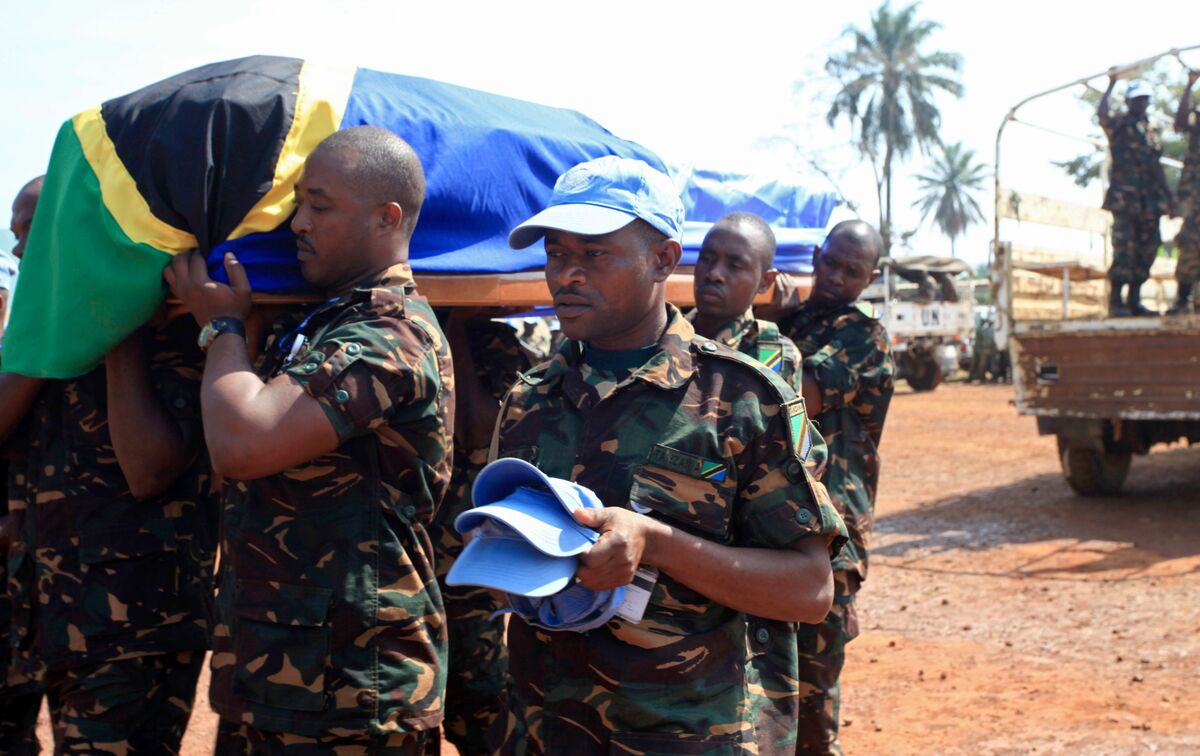
A day after 15 United Nations troops were killed by militants in eastern Congo, the organization’s chief of peacekeeping operations described the deadliest assault on UN forces in a quarter-century as retaliation for the mission’s aggressive approach.
The attack came because of the “increasingly robust posture” the UN’s “blue helmets” maintain in the troubled country, Jean-Pierre Lacroix, a former French diplomat who’s the UN’s undersecretary general for peacekeeping operations, told reporters. “We are disturbing them,” he said of the armed groups suspected of being behind the Dec. “They do not like it.”
The battles peacekeepers face in the field come on top of the political and budgetary pressures Lacroix has to manage from the U., the UN’s biggest donor nation, as President Donald Trump’s administration continues pressing the global body to rein in costs and end ineffective missions.
After taking office in January, U. Ambassador to the UN Nikki Haley led an effort to trim about $600 million from the UN’s $7.3 billion peacekeeping budget for the fiscal year ending in June 2018. -- which pays 28.5 percent of the peacekeeping budget -- had initially demanded $1 billion in savings, citing the high cost of the operations and deployments that were too long. Repeated allegations of sexual abuse by UN forces against civilians further damaged the reputation of the peacekeepers.
‘Be Prudent’
“We have to be extremely thoughtful in how we allocate our resources,” Lacroix said in an interview in his office on the 35th floor of the UN’s headquarters in New York. “There is an expectation that we be prudent and use our resources in the most cost-effective way we can.”
Lacroix, who assumed his post in April, is the fifth consecutive French head of the peacekeeping department. In that role he oversees 106,000 blue-helmeted troops across 15 missions. The peacekeeping effort in Congo is the largest and most expensive, encompassing more than 18,000 troops and about 3000 civilians, with a budget of $1.
With the increasing budgetary demands, the UN may be moving toward a future where creaky peacekeeping missions with large footprints in collapsing countries are no longer the norm. But that will take a while.
“The UN is bogged down in places like the Congo and South Sudan where there is no realistic chance of establishing lasting peace in the foreseeable future,” said Richard Gowan, a UN expert with the European Council on Foreign Relations. “The peacekeepers can’t just shrug and walk away from these trouble spots.”
Last week’s death toll in Congo, which has struggled with decades of conflict that has displaced millions of people, highlights the risk peacekeepers increasingly face by getting caught between warring parties and fulfilling a mandate to protect civilians fleeing conflict. In Congo, unlike some other missions, the UN has a mandate to pursue offensive operations against armed groups, although it is often poorly equipped and trained for the task.
‘No Exit Strategy’
“These missions can’t affect the situations militarily and spend most of their capabilities protecting themselves,” said Arthur Boutellis, a senior adviser at the International Peace Institute in New York. “Mandating the missions to protect civilians means there is no exit strategy for the peacekeepers.”
Lacroix, 57, agrees changes are needed.
“We need to have a force that increases its ability to detect and prevent these threats and also has more capacity in terms of rapid reaction,” Lacroix said. “This has to do very much with the kind of training that troops have, the equipment that they have. We have been insisting on more intel capabilities, more mobility.”
A graduate of the Paris Institute of Political Studies, Lacroix spent 25 years as a diplomat in Prague, Stockholm and Washington. His one-year contract ends in April and is effectively an audition for the more typical five-year contract at the UN. He has to show progress in implementing the secretary-general’s vision, for example, by decentralizing management and improving assessments of performance and accountability.
In recent years, the number of blue helmets has increased significantly: peacekeeping numbers jumped from about 20,000 in 2000 to more than 100,000 in 2017. Now there is a push to reverse that trend.
Africa Focus
The majority of peacekeeping troops are in Africa, operating in areas such as the Central African Republic, the Darfur region in Sudan, the Democratic Republic of Congo, Mali and South Sudan, accounting for about 70 percent of the $7.3 billion peacekeeping budget. Beyond Africa, there are missions in Kosovo, the India-Pakistan border, Cyprus and Lebanon.
By the end of summer all missions will undergo a strategic review by outside assessors to to determine how to proceed. “We are looking for innovative ideas, we want to encourage thinking outside the box,” Lacroix said.
Some situations are outside of UN’s reach. The civil war in Yemen pits the country’s leaders backed by Saudi Arabia against Houthi rebels believed to be backed by Iran. The UN has warned of a humanitarian catastrophe in Yemen with 17 million people facing famine because of the conflict and a Saudi blockade of key ports. But Lacroix could see no chance of a peacekeeping mission to Yemen.
“When belligerence is prevalent it is difficult to see how peacekeeping can work,” Lacroix said. “You have forces that are trying to derail the political process.

0 comments:
Post a Comment