
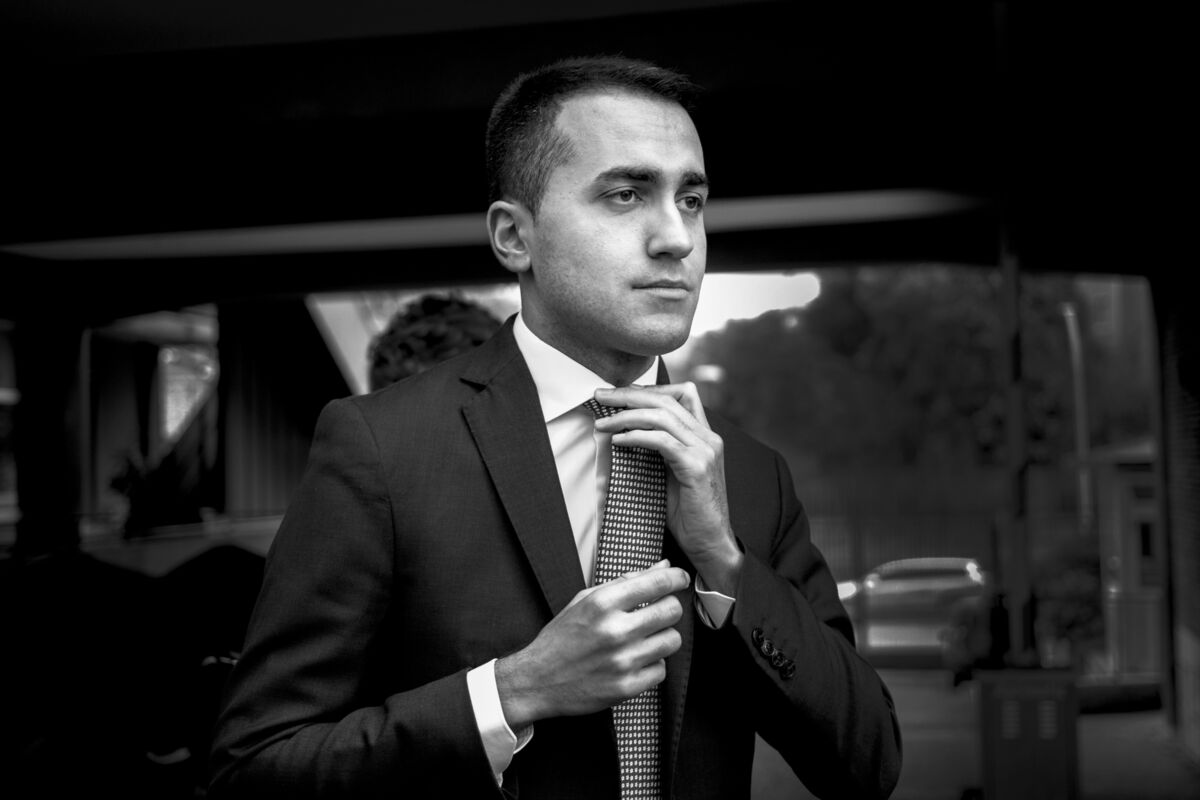
The new face of Italy’s anti-establishment Five Star movement courts investors in London, meets with American legislators and woos Italian businesses. And he was the only kid in his public high-school class to wear a necktie.
Luigi Di Maio, 31, has turned Five Star into Italy’s single biggest political force, according to surveys published before a two-week blackout period on polling ahead of March 4 elections. No party is likely to get a majority to govern, but Di Maio may emerge with huge bargaining power when it’s time to form a government. That could help him champion the party platform of more spending for the poor, curbs on immigration and renegotiating European Union treaties.
His style couldn’t be more different from that of party founder Beppe Grillo, a disheveled former comedian known for his public rants, his politically incorrect language and his rabid euro-skepticism. The short-haired, clean-shaven Di Maio, by contrast, calmly discussed “Byzantine” banking laws and non-performing loans in an interview with Bloomberg Television last month
“The image Di Maio projects underlines the change of season in Five Star,” said Fabio Bordignon, a political science professor at the University of Urbino who has studied the party’s rise. “Grillo represents the anger of Italians, he sweats, screams, swears. Di Maio is the cold leader, he never swears, he’s always impeccable.”
The eldest of three children, Di Maio grew up in Pomigliano D’Arco, an industrial town on the outskirts of Naples. His mother was a school teacher and his father was a small businessman who dabbled in far-right politics. By high school, Di Maio was already active politically, leading the students’ association and organizing student and parent protests to get a new building built. He succeeded, and laid down the new school’s first stone with the town mayor, recounted Antonio Cassese, Di Maio’s high-school history and philosophy teacher.
“He was the only one in his class to wear a tie, but the other students didn’t mock him, they respected him,” said Cassese, who plans to vote for Five Star in this election although he voted for the center-left in the past. “A few years ago I thought Luigi was too linked to Grillo, it felt like a kind of psychological dependence. But now I see he is trying to be more autonomous.”
Di Maio has been involved with Five Star since its creation in 2009, participating in campaigns against corruption and in favor of direct democracy, which includes choosing candidates through online voting. The movement started off by tapping into the frustration of people who felt left behind by the financial crisis and often blamed the country’s economic decline and lack of independent decision-making on the EU and the introduction of the euro.
By 2013 Five Star had managed to win over 100 seats in the lower house of the Italian parliament and Di Maio was among the new lawmakers. A month later, the young man from the south, who hadn’t completed his engineering degree at university, became the Chamber of Deputies’ youngest ever vice-president.
His ambitions were apparent by that time. While walking in central Rome one day, he looked up at the Prime Minister’s residence and said to Nicola Biondo, a former party spokesman who wrote a book about Five Star. “When we are there, you’ll come with me.”
“He’s long had his sights on the premiership,” said Biondo, co-author of “Supernova: How the Five Star Movement Was Killed.”
In 2017 Di Maio became Five Star’s candidate for premier, once again through an online vote. Opponents criticized the tally, saying it was orchestrated by Grillo and Casaleggio Associates, the firm behind the movement’s rise to power. It’s headed by Davide Casaleggio, son of the late web consultancy guru and Five Star co-founder Gianroberto Casaleggio. Davide Casaleggio is also one of the partners behind Internet platform Rousseau, which handles Five Star primaries, receives donations and keeps tabs on members.
This concentration of power in the hands of a company and the influence of its non-elected managers on the movement has raised questions from the political opposition about accountability and transparency. Similar criticism has been leveled at Five Star’s expulsions of any member of parliament who breaks at all with the party line.
“It’s in some ways a bit like a sect,” said Marianna Rizzini a journalist for Il Foglio newspaper. She started covering Five Star in 2010 and described some of Grillo’s first rallies as “anger fests,” with people venting their frustrations at the political and social system. Now, the party requires its legislators to sign a contract pledging loyalty to the movement, even though Italy’s constitution specifically allows freedom of choice in parliament.
A spokeswoman for Five Star didn’t respond to a request for comment.
AllAbout Five Star, Bane of Italy’s Establishment: QuickTake
Investors worried about Italy’s mammoth debt and still relatively weak economy have been troubled by Five Star’s anti-euro rhetoric and proposals to increase public spending, which include a pledge to guarantee the less fortunate with a monthly citizen’s income.
To reassure markets and voters, Di Maio has been engaged in a delicate balancing act. He’s backpedaled on pledges to leave the euro and traveled to London earlier this year to reassure the world of global finance- including hedge fund and other investors – about the party’s chances of ensuring a stable government.
He also met officials at the U. State Department and Congress in Washington in November and met the Vatican’s secretary of State Cardinal Pietro Parolin. In a further charm offensive, he recently visited small and medium-sized companies in the wealthy northern region of Lombardy, where Five Star has historically done less well.
De Maio’s push toward the mainstream may alienate some of Five Star’s original support base as he turns away from its roots as a protest movement standing up against the ruling class. Tensions building inside the party and a Five Star rule that limits elected officials to only two terms means Di Maio is gambling a lot.
“If Five Star doesn`t do well, he`ll be the one who gets the blame,” said Bordignon, the professor. “He has just this chance.”
— With assistance by Giovanni Salzano.

0 comments:
Post a Comment