
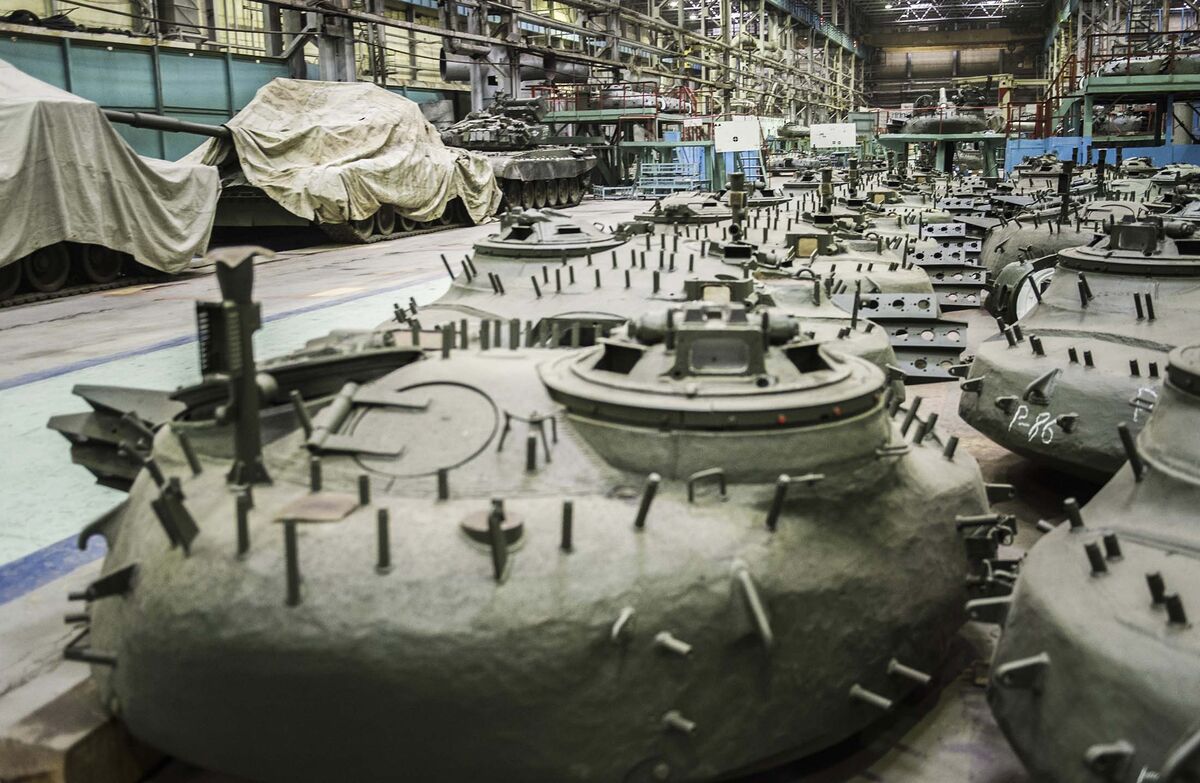
Six years ago, when President Vladimir Putin last ran for president, workers at the UralVagonZavod factory in Nizhny Tagil volunteered on national television to come to the capital to confront the Muscovites who’d taken to the streets to protest his continued rule. In early March he was back at the Ural Mountains plant for a campaign stop, telling employees, “I tried not to let you down.”
While no one in a hand-picked group of listeners there challenged him, the mood among some of their colleagues in the gritty city isn’t nearly so upbeat. Layoffs and wage cuts have swept the state-owned company, a Stalin-era giant that churns out battle tanks and other heavy equipment. “Salaries are down 40 percent,” says Alexei Dimitrov, who heads a small union at the factory that’s filed a suit challenging the wage cuts. “They left us no alternative but to go to court.”
Even with Putin cruising to a virtually certain win in the March 18 election, the Kremlin is worried that pocketbook issues are a growing liability. Never mind that a credit rating company elevated Russia out of the “junk” category last month. For many, the pain of the most recent recession—which at seven quarters was the longest of Putin’s rule—lingers. Video simulations showing new missiles seemingly targeting Florida got most of the attention at Putin’s state of the nation address on March 1, but he actually devoted more of the speech to promising to lift living standards that are lower than they were during his last campaign.
“We need to make a decisive breakthrough in the prosperity of our citizens,” Putin said. “Falling behind is the main threat, that’s our enemy.” He pledged to halve the number of Russians living in poverty—now 20 million—and boost per capita income by half by the middle of the next decade.
Putin’s ambition at the start of his 18-year rule was to overtake Portugal in living standards—a milestone that looks increasingly out of reach. Incomes more than doubled in the first decade of his tenure, but they’ve stalled and are roughly where they were in 2010. In a January poll commissioned by the central bank, almost two-thirds of Russians said their financial situation hasn’t improved in the past 12 months, and nearly half expect little difference over the coming year.
With little prospect for another big runup in oil prices or an easing of Western sanctions, the Kremlin’s options for igniting growth are limited. The central bank estimates the best Russia can hope for is 1.5 percent to 2 percent a year. Among the factors holding back the economy are a shrinking workforce and years of underinvestment.
In his speech, Putin cataloged trillions of rubles in spending planned for health care, pensions, and roads, but he was vague about how he’d pay for it. Despite the recent upgrade in its credit rating, Russia is unlikely to significantly step up its foreign borrowing, as the Kremlin remains wary of increasing Western leverage over the country, particularly with sanctions in place. That’s why his aides have spent months working up a package of painful measures to offset planned new spending, according to people involved in the discussions.
Among the proposals on the table are raising income taxes and eliminating breaks for food and other necessities, as well as trimming benefits. Near the top of the list is an increase in the retirement age, now 60 for men and 55 for women. “If we don’t raise taxes or the pension age, it will be difficult to seriously improve pensions and the quality of health care,” said Maxim Oreshkin, minister for economic development, during a March 5 appearance on a late-night talk show.
“The challenge for the next term is to set in motion the mechanisms of restructuring the economy, shifting its structure toward sectors that develop human capital,” says Yaroslav Kuzminov, dean of the Higher School of Economics in Moscow and a frequent adviser to the government on economic policy. Curbing the country’s reliance on oil and gas exports is easier said than done, though—just ask Saudi Arabia. Boosting investment in education and infrastructure is a good start, but it may not be enough to arrest Russia’s slide in the economic league tables. The country broke into the top 10 in 2008, after almost a decade of oil-fueled growth, but it will fall back to No. 17 within the next 15 years as South Korea, Spain, and Turkey, among others, leapfrog it, according to a December study by the Centre for Economics & Business Research in London.
In Nizhny Tagil, Dimitrov and his colleagues at UralVagonZavod aren’t having much success in the courts with their legal challenges to the wage cuts. But they got a little boost just a few days before Putin’s visit, when the factory unexpectedly announced a raise of 6 percent, the first since 2016. “That will improve the workers’ mood a bit,” but it’s far from enough to make up for the losses of the last few years, Dimitrov says.

0 comments:
Post a Comment